Key Takeaways
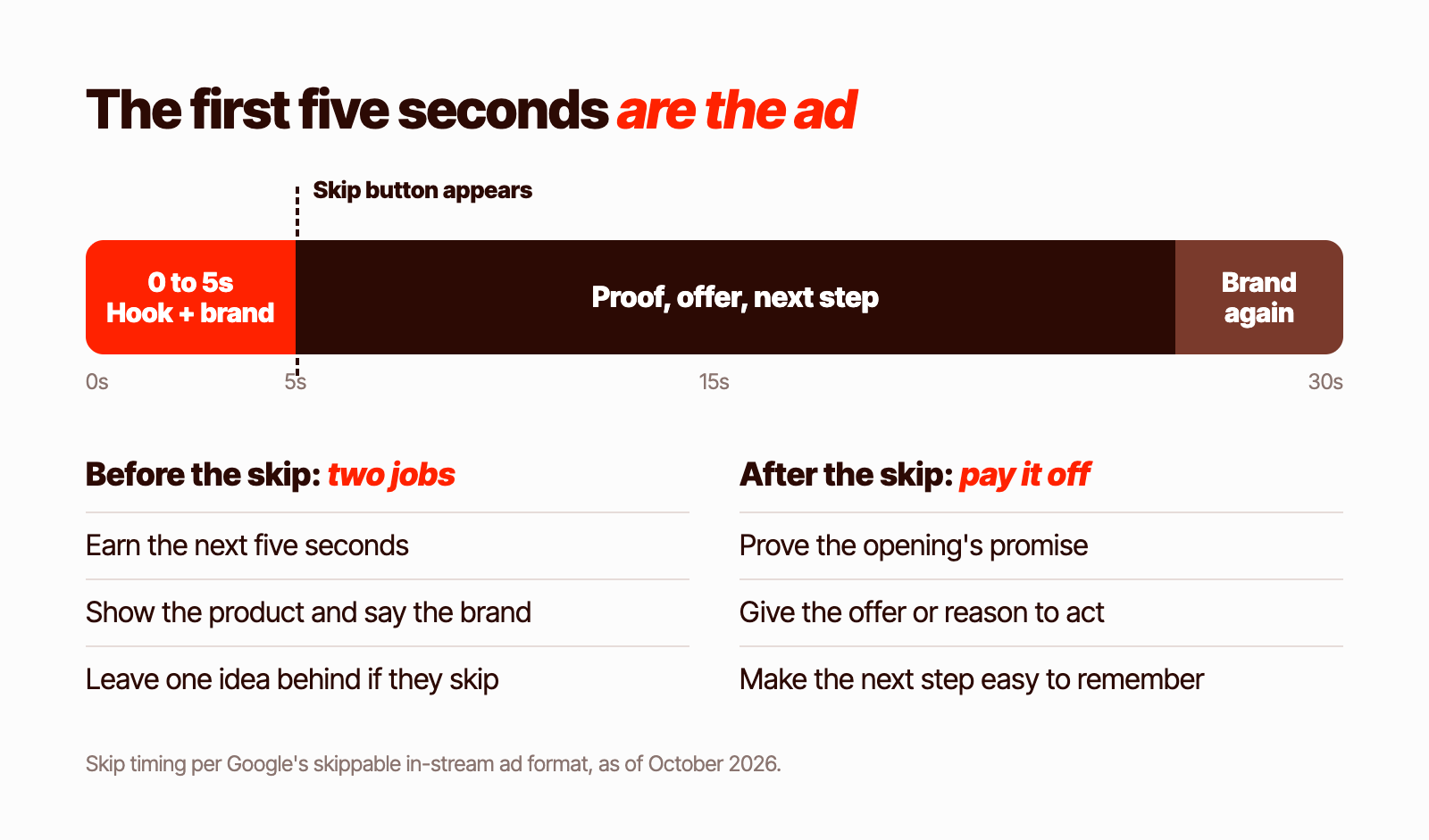
- On skippable YouTube ads, viewers can skip after five seconds. Write as if most of them will.
- The first five seconds have two jobs: earn the next five, and leave something behind if they don't.
- Get the brand in early, on screen and out loud. Google's own creative guidance says to introduce the brand from the start.
- YouTube runs on TVs too. Write for sound, not just captions.
- Test openings, not whole ads. Make several first five seconds for the same body and keep the one that holds.
Most YouTube ads are written like the viewer is going to watch the whole thing.
They aren't. On a skippable in-stream ad, the skip button appears after five seconds, and that's the moment the ad either earns attention or loses it.
That changes how you should write. The opening isn't a warm-up. It's the ad. Everything after it is a bonus for the people you've already won.
This is how we approach the five-second skip when we make YouTube ads, with examples from spots we've made for clients.
How the Skip Actually Works
A few facts worth knowing before you write, from Google's own ad format guide:
- Viewers can skip after five seconds on skippable in-stream ads.
- There's no maximum length, though Google recommends keeping them under three minutes.
- With cost-per-view bidding, you pay when someone watches 30 seconds (or the whole ad if it's shorter) or clicks, whichever comes first. With impression-based bidding, like target CPM, you pay for the impression either way.
- Bumper ads run up to six seconds and can't be skipped.
That billing rule matters. If you're buying on cost per view and someone skips at second six, you usually don't pay for that view. So if your brand and your core idea are on screen in those first five seconds, a skip isn't a total loss. It's an impression that still did some work.
The Two Jobs of the First Five Seconds
Every YouTube opening has to do two things at once.
Job one: earn the next five seconds. Give the viewer a reason not to skip. A question they want answered, a problem they recognize, something they didn't expect to see.
Job two: leave something behind if they skip anyway. The brand, the product and the one idea you'd want them to remember. If someone skips at five seconds and can't tell you who the ad was for, the opening failed.
Most ads only try to do one. Brand-heavy openings feel like ads and get skipped. Clever hooks that hide the brand win attention but leave nothing behind. You want both.
Six Openings That Earn the Next Five Seconds
1. Name the Problem
Open with the frustration your buyer already feels. If they nod, they stay.
For Uber Eats, this spot opens with "Tired of waiting for takeout?" over a receipt, then shows how Pickup solves it.
2. Ask a Question They Want Answered
A question creates a small gap the viewer wants closed. For iHerb, a creator opens with "Guess who I ordered my supplements from," and the answer is the brand.
3. Say Something Bold
A surprising statement stops people. For Mood, the spot opens with "Leave the tariffs in 2025," then "Leave the alcohol in 2025," with animated gummy characters bouncing across the frame. You know what the product replaces before you've had time to reach for the remote.
4. Show the Product Doing the Thing
If your product has a visual payoff, lead with it. A before and after, a demo or a result in the first second answers "why should I care" without a word.
5. Put a Real Person on Camera
A face talking straight to camera feels like content, not an ad. Creators and customers work especially well on YouTube, where people are used to watching people talk.
6. Start in the Middle
Skip the setup. Open mid-action or mid-sentence, then let the story catch up. The viewer stays to figure out what's going on.
Get the Brand In Early
There's a long-standing fear that showing the brand early makes people skip. Google's own guidance goes the other way. Its ABCDs of effective video ads say to introduce your brand or product from the start and keep it present, and note that saying the brand name out loud strengthens the on-screen branding.
Google says ads that follow the ABCDs can deliver as much as a 30% lift in short-term sales likelihood, based on research with Kantar.
In practice, branding early doesn't mean opening on a logo card. It means:
- The product is in frame in the first few seconds.
- The brand name is said out loud, not just shown.
- The brand's look is obvious: colors, packaging, type.
For Uber Eats, this spot opens on the logo and the app, then walks through a day of moments. There's no doubt whose ad it is, even if you skip at second five.
Write for Sound
On Meta, most people watch with the sound off. YouTube is different, and more and more of it plays on TVs, where the sound is on and the viewer may be across the room.
So write the opening for the ear as well as the eye:
- The first line should work on its own. If someone only hears it, they should get the point.
- Say the brand. Hearing it does work that seeing it alone doesn't.
- Use music and sound design on purpose. A sound cue can earn attention as well as a visual one.
- Keep supers short. Text supports the voiceover. It doesn't replace it.
For more on writing for the big screen, see the ultimate guide to making CTV ads.
After the Skip Button
If someone stays past five seconds, you've earned a little patience, not a lot. Use it in this order:
- Proof. Show why the opening's promise is true: a demo, a comparison, a review, a result.
- The offer or reason to act now.
- A clear next step. On a phone, a click. On a TV, something easy to remember, like a short URL or a QR code.
- The brand again at the end. Bookend it.
Keep it tight. A 15 or 30 second skippable ad that earns its length usually beats a two-minute one that wanders, even though there's no maximum.
Test Openings, Not Whole Ads
The most useful thing you can test on YouTube is the first five seconds.
Instead of making five different ads, make one strong body and three to five different openings for it. Each opening is a different bet on what earns attention: a problem, a question, a bold line, a demo, a face. Run them against each other and keep what holds people past the skip.
Then judge the winners on what they actually drive, not just how many people stayed. In our own data on Meta, the ads that got the most spend didn't have higher hook rates than the rest. Attention is the first step, not the result. More on that in our hook rate benchmarks.
It's also worth making a six-second bumper from your best opening. Bumpers can't be skipped, so they're a cheap way to repeat the brand and the core idea to the same people.
Don't Forget Shorts
YouTube Shorts are vertical and play in a feed, more like Meta and TikTok than TV. If you're running both, cut vertical versions from the same project rather than reusing the landscape spot. The opening rules are the same. The frame isn't. For specs on landscape versions, see our CTV ad specs guide.
Common Mistakes
- Opening on a logo card with nothing else happening.
- A slow build that saves the point for second 20.
- Hiding the brand until the end, so skippers never learn whose ad it was.
- Relying on captions when the viewer is listening.
- One opening, no tests.
- Judging by view rate alone instead of what the ad drives.
- Reusing a vertical social ad as a landscape YouTube ad. More on adapting social winners in your best TV ad is probably already running on Meta.
A Quick YouTube Ad Checklist
Before a skippable YouTube ad goes live, check that:
- The first five seconds give a reason to keep watching.
- The brand is on screen and said out loud in those five seconds.
- The product is in frame early.
- The opening line makes sense if you only hear it.
- Someone who skips at five seconds would know whose ad it was and what it's about.
- Seconds 5 to 30 deliver proof, an offer and a clear next step.
- The brand comes back at the end.
- You have at least three openings to test.
- There's a six-second bumper cut from the best opening.
- There are vertical cuts for Shorts if you're running there.
How We Make YouTube Ads at Biddyco
Our CTV and YouTube creative agency makes skippable and non-skippable YouTube ads with hooks built for the five-second skip, plus the opening and length variations you need to find what works. It's the same U.S.-based team that makes our clients' Meta and TikTok ads, so the best-performing social concepts become the starting point.
We've made CTV and YouTube spots for brands like Uber Eats, iHerb, Maximus and Project Food Box. If you're comparing partners, our buyer's guide to hiring a CTV creative agency covers what to ask. Or book an intro call to talk through your account.
FAQ
When can viewers skip a YouTube ad?
After five seconds, on skippable in-stream ads. Bumper ads, which run up to six seconds, and non-skippable in-stream ads can't be skipped.
Do you pay when someone skips a YouTube ad?
It depends on how you bid. With cost-per-view bidding, you pay when someone watches 30 seconds, or the whole ad if it's shorter, or interacts with it. With impression-based bidding, like target CPM, you pay for the impression.
Should you show your brand in the first five seconds of a YouTube ad?
Yes. Google's own creative guidance says to introduce the brand from the start and keep it present. Show it and say it, so even people who skip know whose ad it was.
How long should a skippable YouTube ad be?
There's no maximum, and Google recommends under three minutes. For most performance ads, 15 to 30 seconds is enough to land the hook, the proof and the next step.
What's the best way to start a YouTube ad?
Name a problem, ask a question, say something bold, show the product working, put a real person on camera or start mid-action. Test several openings against the same body to find the one that holds.
Do YouTube ads need sound?
Write them for sound. A growing share of YouTube plays on TVs, where the sound is on. The opening line should make sense even if the viewer is only listening.