Magic Spoon took the cereal you grew up on and rebuilt it: high protein, low carb, zero sugar and still sweet enough to taste like childhood. It's also one of the best-known challenger brands in CPG, having grown from a DTC startup into a brand on shelves across the country.
We worked with Magic Spoon for two years. When they came to us, they had a lot going for them and one big problem. They were scaling their Meta spend fast, but kept hitting plateaus because they didn't have enough of the right creative to keep feeding the account. So each month we met with their team, looked at what was working in their account and across our other brands, and made the next round of new concepts and iterations.
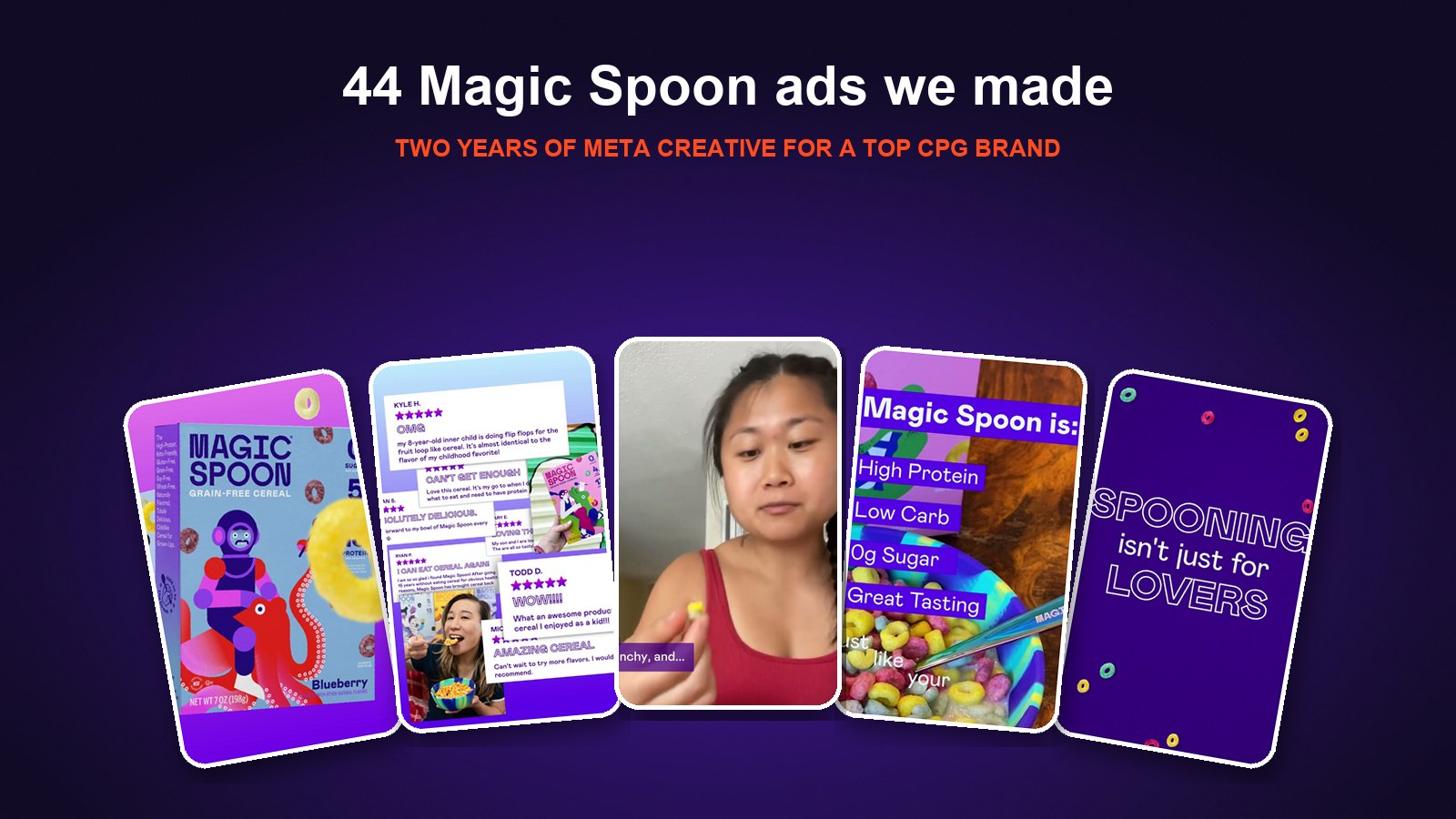
We're no longer working together, but the work is a good look at what two years of monthly creative for a fast-growing CPG brand looks like. Below are 44 of those ads, grouped by the approach behind them. Together they're a pretty complete picture of how we think about creative for CPG and DTC brands: lots of formats, one clear message, and a steady stream of new ideas.
"As we aggressively scaled our ads, we found that ad creative was starting to become a bottleneck. Our brand identity is just as important as performance, and we're always skeptical that a creative partner can deliver on both simultaneously. Thankfully, we've found that Biddyco can create ads that are as beautiful as they are effective."
Gabi Lewis, Co-Founder, Magic Spoon
The One Message Behind All 44 Ads
Almost every Magic Spoon ad we made comes back to the same tension: it tastes like the cereal you loved as a kid, but it's actually good for you. High protein, low carb, zero sugar, and still sweet.
That's the strength of a good CPG brand. The product benefit is simple and doesn't change. What changes is the way it's told: a comparison chart, a creator taste test, a meme, a Black Friday banner, a text conversation. Each new format finds a different person who hadn't paid attention to the last one. That's creative diversity, and it's exactly what Meta's Andromeda update rewards.
1. "Us vs. Them" Comparisons
When your product is a healthier version of something people already eat, the fastest way to explain it is to put the two side by side.
Us vs. Them. A simple nutrition face-off: Magic Spoon's 14g protein and 0g sugar next to a typical fruity cereal's 2g protein and 11g sugar, then "Same great taste with grown-up ingredients."
Still eating the sugary cereal from your childhood? A split screen of Magic Spoon next to "other cereal" drowning in sugar, then "just like your childhood favorites... but healthier."
Your current breakfast vs. Magic Spoon. Toggle switches flip from "your current breakfast" to Magic Spoon for high protein, low carb, childhood taste and 25,000+ five-star reviews.
Cereal bar vs. them. For the bar launch, animated bars compare Magic Spoon to a typical bar: 1g vs. 6g sugar, 4g vs. 14g net carbs, 10g vs. 7g protein, 130 vs. 200 calories.
We reimagined your favorite childhood cereals. Wheat and sugar cubes fly out of frame as the stats land: "Adult ingredients. Addictively delicious flavor."
Comparison ads work because the viewer is already making the comparison in their head. Doing it for them, with real numbers, removes the guesswork.
2. Nutrition, Made Visual
Macros are the product, but a list of numbers isn't an ad. These use motion to make protein, carbs and sugar feel like the exciting part.
The Waterfall. Boxes tumble down the screen while "4g net carbs," "13g protein" and "0g sugar" land one at a time.
Magic Spoon = Protein. Each flavor cycles through with its real-world inspiration flying around the box, from chocolate to peanut butter, under "rockin' taste."
That's the magic of Magic Spoon. A single cereal piece transforms as the copy explains the recipe: remove the sugar and grain, add a ton of protein and natural flavors.
Part of a balanced breakfast. "Why has cereal always been part of a balanced breakfast..." flips a line everyone knows from cereal commercials.
As easy as one, two, three. Cereal pours in slow motion as the stats build, then "It's as easy as one, two, three."
We took cereal... Illustrated weightlifters and falling cereal tell the story: cut the grain and sugar, load it with protein, make it taste insanely good. Real creator reactions finish it.
How can it be... A series of questions answered by the product: perfect for a midnight snack and your fitness goals? Sweet like your childhood faves with 0g sugar? "It's Magic."
We make this kind of work on our motion ad agency side. For a nutrition-led CPG brand, motion is how you turn a nutrition panel into something people want to watch.
3. UGC and Taste Tests
The biggest objection to healthy cereal is "yeah, but does it taste good?" Nothing answers that like real people eating it.
Does it actually taste good? Replying to a real comment, "Magic Spoon is healthy, but does it actually taste good?", creators answer: "Crunchy," "It's really good," "Bro, this is FIRE."
For the sweet tooth. "Trying to avoid sugar but have a major sweet tooth?" A scroll of creator clips and a five-star review: "Kids LOVE this cereal! They would never know it was good for them!"
Your vision board in cereal form (UGC). Creators unbox, pour and eat, framed as a New Year's goal.
Manifest better breakfast habits (UGC). A second New Year cut with different creators and the same message.
POV: finally eating a wholesome breakfast as an adult. An ASMR-style pour and crunch with the benefits overlaid.
Hear that? A cat watches a bowl being poured: "It's the sound of a hearty breakfast."
AirDrop. "Your New Year's goals would like to send you a breakfast pro tip," with creator clips playing inside an iPhone AirDrop prompt.
UGC like this is what we make on our UGC ad agency side. The AirDrop ad is a good example of a UGC hybrid: creator footage inside a designed frame.
4. Social Proof and Press
A new kind of cereal asks people to take a chance. Reviews, customer counts and press coverage make that chance feel safe.
40,000+ reviews. A review counter climbs past 40,000 and a stack of five-star reviews piles up: "If you've been waiting to try Magic Spoon, consider this a sign."
Over a million customers. "Over a million customers are enjoying Magic Spoon," then a Delish quote: "They taste really, really good. Like, you wouldn't know they're healthy kinda good."
As seen in Parade. A Parade article naming Magic Spoon the best keto-friendly cereal, presented as a clean press card.
Everybody loves Magic Spoon. "Kids love, grown-ups love, midnight snackers love... everybody loves Magic Spoon," over a ticker of 20,000+ five-star reviews.
The search bar. A search for the "most protein-packed, low carb, good-tasting cereal out there" opens into a collage of real customers: "Stop searching, try a bowl today."
We've broken down more of these approaches in 11 ways we build press and social proof into Meta ads.
5. Objection Handling
Some ads exist to answer one specific doubt before it stops a purchase.
The customer service reply. Real-looking comments ("it's so expensive for cereal," "does it have a weird aftertaste?") get answered with Magic Spoon's 100% happiness guarantee.
Love the protein, hate the taste? Chunks of a chalky protein bar in a bowl of milk give way to Magic Spoon: "Protein has never tasted so good."
Counting macros. "Tired of the same old snacks while counting macros?" Hard-boiled eggs and jerky make way for "the ultimate high protein, low carb snack."
Be like Ben. A simple character story: Ben keeps keto, Magic Spoon is his go-to for breakfast, snacks and sometimes dinner without breaking his diet.
6. Native and Meme Formats
Ads that look like something you'd actually see from a friend get watched instead of skipped.
The red flag meme. "'I don't like Magic Spoon' 🚩🚩🚩" over a slow-motion spoonful. Six seconds, no explanation needed.
The text thread. A friend texts "You HAVE TO try this cereal," the reply is "I've cut out cereal because of the sugar," and the conversation turns into a tour of the site: "Honestly it tastes just like cereal I ate as a kid, andddd it's healthy."
The Post-it notes. Handwritten sticky notes ask "How can I protein pack my mornings without sacrificing taste?" and answer it, ending on "Become a Spooner today."
Seeing it everywhere. Text bubbles like "OMG I think I finally found a healthy cereal replacement" and "I've been seeing it everywhere! Does it taste good??" over a collage: "Try the cereal everyone is talking about."
7. Seasonal and Cultural Moments
An always-on brand needs reasons to show up fresh. Holidays and new-year resolutions give the same message a new hook.
Black Friday. "The Black Friday sale is here!" with a scrolling "20% off" border and cereal raining into a bowl, a simple moving still built for a sale.
Valentine's Day. "Spooning isn't just for lovers." A cereal heart and "Fall in love with your favorite new cereal."
New Year: your vision board in cereal form. The animated version of the New Year concept, with benefit callouts floating around two bowls.
New Year: manifest better breakfast habits. Stacked bowls and callouts in a second animated New Year cut.
The January declutter: skillet-free. "Your skillet-free, protein-packed breakfast does exist," set against eggs and English muffins.
The January declutter: no more dishes. "Magic Spoon just solved your sink-full-of-dishes problem."
Running the New Year concept as both motion and UGC (sections 3 and 7) is a pattern we use often: one idea, two formats, and a real test of which one the audience prefers.
8. Recipes and Everyday Uses
Upping your protein's never been so fun. Magic Spoon on pizza, in a kid's art project and blended into a smoothie.
Fuel your day. Cereal in a peanut butter sandwich, a protein shake and a toddler's bowl, with the macros on screen.
Showing new ways to use a product gives existing customers a reason to buy more and new customers a reason to see it as more than breakfast.
9. Launching New Products: Bars and Bundles
The same magic, bowl-free. The cereal bar launch: 1g sugar, 4g net carbs, 10g protein, "tasty & crunchy."
All the places you can enjoy Magic Spoon cereal bars. Point-of-view clips on a skateboard, at a coffee shop and on long drives: "Take one with you anywhere."
All the places (alternate cut). A shorter version of the same concept for testing.
Build your own box. Bundles for every personality, like "The Chocoholic," "The Classics Fan" and "The Loyalist."
Launch ads have a different job than evergreen ones: they need to explain something brand new fast, then tie it back to the product people already love.
What 44 Magic Spoon Ads Teach About CPG and DTC Creative
- Keep the message steady and the format moving. Magic Spoon's promise barely changes. The formats, hooks and moments change constantly.
- Answer the biggest objection over and over. "Does it taste good?" shows up in taste tests, reviews, comparisons and memes. Each version reaches someone new.
- Use motion to make nutrition exciting. For better-for-you brands, animated macros and comparisons turn a label into a reason to buy.
- Show up for moments. Black Friday, Valentine's Day and New Year give a familiar message a fresh reason to run.
- Test concepts in more than one format. The New Year idea ran as both motion and UGC, so the account learned which the audience preferred.
- Feed the account every month. Scaling spend means a steady pipeline of new concepts and iterations, not one big campaign.
If you're a CPG brand, see how we work on our CPG creative agency page, or browse 32 more CPG ad examples. DTC brands can see 10 DTC ad examples and our DTC creative agency page. And if you're weighing budget, here's what a creative agency for Meta ads costs.
Work With the Team That Made These Ads
Biddyco is a creative agency for Meta ads for CPG and DTC brands spending $100K–$5M+/month. Our in-house team makes UGC, motion, hybrid and static ads on a flat monthly retainer, with a steady pipeline of new concepts every month.